Authentic Korean Jajangmyeon (VIDEO)

This post may contain affiliate links. Please read our disclosure policy.
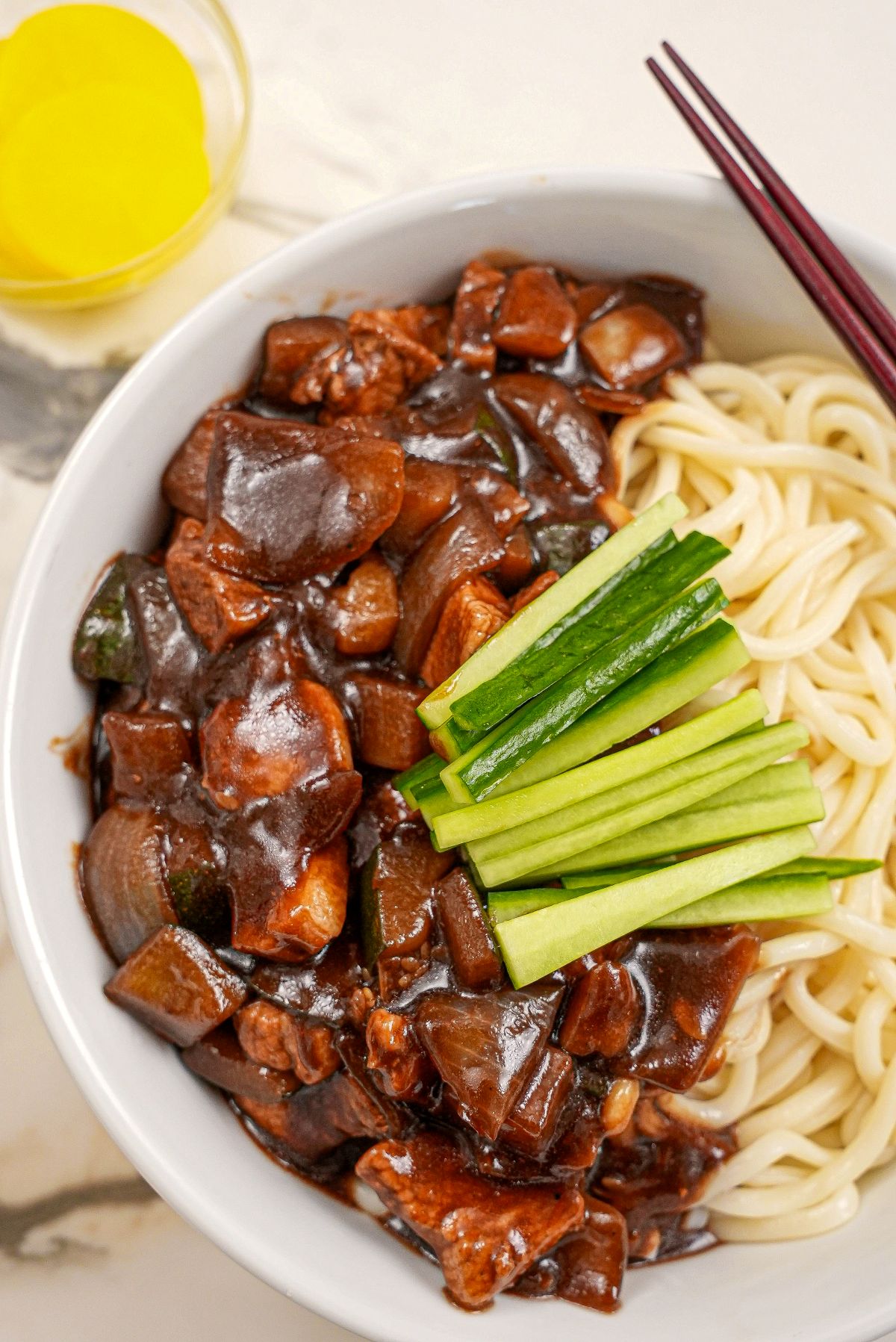
Jajangmyeon, or Korean black bean noodles, is a beloved Korean-Chinese dish – bouncy, chewy wheat noodles are topped with a savory sauce (mine has pork belly) that is out-of-this-world good! You’ll find this in many Korean restaurants across the world, and my authentic Jajangmyeon recipe uses pork belly, vegetables, and Korean black bean paste for that signature bold, umami taste that brings these restaurant-quality noodles to you right in the comfort of your home!
Watch the Jajangmyeon Recipe Video!
A Note from CJ
Jajangmyeon is a Korean-Chinese classic!

I remember the first time I had jajangmyeon, I was blown away! The savory sauce over the chewy noodles – I couldn’t get it enough! It was served alongside some of my favorite Korean sides (banchan) – dishes like Korean Braised Potatoes, Korean Fish Cakes, Korean Egg Roll, Korean Bean Sprout Side Dish, Korean Marinated Eggs (Mayak Eggs), and Korean Spinach Side Dish!
You can serve this alongside popular Korean BBQ dishes like Korean Marinated Short Ribs (LA Galbi), Beef Bulgogi, and Spicy Pork Bulgogi!
Amazing! Reminds me of my grandmas!!
Ingredient Tips
Refer to the recipe card for the full list of ingredients and measurements!
- pork belly – cut into 1″ pieces; you can also use pork shoulder. If you don’t want to use pork, you can really use any protein of your choice (or even mushrooms or tofu, for a vegetarian option).
- vegetables – I used zucchini, daikon radish, and potatoes. I like this combination because all three are mild in flavor but vary in texture and softness when cooked. Make sure to cut the vegetables into similar sizes/shapes so they cook evenly.
- black bean paste – Korean black bean paste (also called ‘chunjang’) is a main ingredient for the sauce – it’s a thick, almost black paste that is made from fermented soy beans and is salty, slightly bitter, with a hint of sweetness. Frying the black bean paste removes some of that bitterness for a delicious sauce!
- wheat noodles – I used fresh Korean wheat noodles, which I purchased from the refrigerated section of the Korean grocery store. If you can’t find it, you can also use fresh udon or a thick, dried noodle of your choice.
- optional garnishes – yellow pickled radish, sliced cucumbers
How to Make Authentic Jajangmyeon
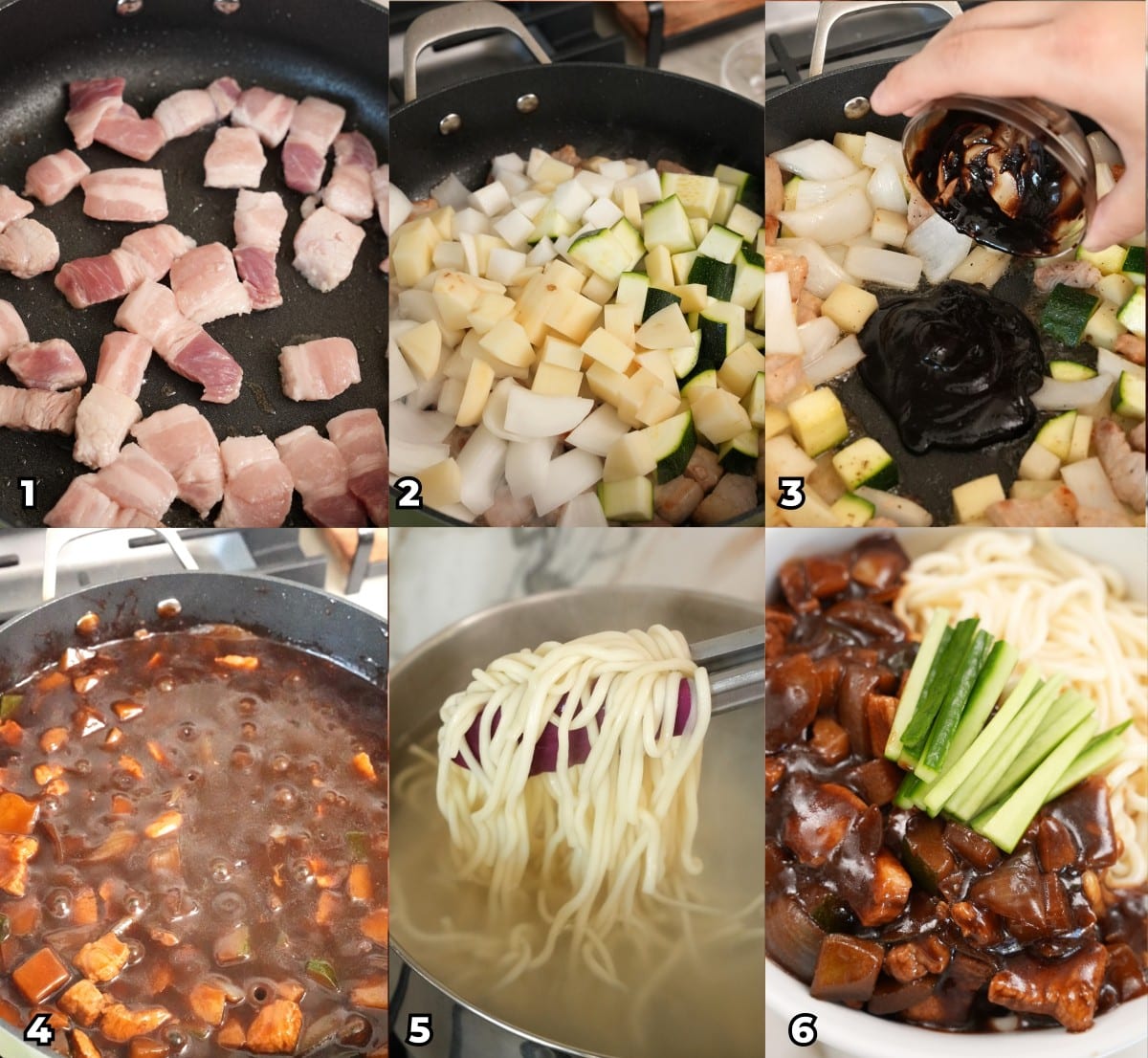
Brown Pork Belly, Add Vegetables, and Black Bean Paste – Cut pork belly into 1″ pieces. Cut daikon radish, zucchini, potato, and onion into 1/2″ chunks. Brown pork belly pieces over medium high heat in 1 tbsp of neutral oil for 2-3 minutes to render out some fat. Add vegetable chunks into pan of pork belly pieces and sauté until softened (3-4 minutes). Season with kosher salt, black pepper, and sugar. In your pan, create a small well in the center of your pork and vegetable chunks. Add black bean paste and fry for 2 minutes before mixing well with the pork and vegetable chunks.
Add Water, Simmer, and Add Slurry – Add the water to the pan and mix until the black bean paste is fully dissolved. Cover and simmer on medium low heat for 8-10 minutes (or until vegetables are tender). Meanwhile, in a separate bowl, mix cornstarch and water into a slurry. Uncover the pot and add the slurry into sauce and stir until thickened. Season with salt and pepper to taste.
Cook Noodles and Pour Sauce Over – Cook noodles according to packaging instructions, until al dente. Immediately rinse under cold water and drain – this will keep the noodles chewy and bouncy. Pour sauce over noodles, serve with yellow pickled radish and cucumbers, mix, and enjoy!
PRO TIPS
CJ’s Storage Tips
Store leftover Jajangmyeon in an airtight container for up to 3-4 days. The noodles will stick together with the sauce – this is normal. Microwave with a splash of water until warmed through.
Store any leftover noodles and sauce (that have not been mixed together) in separate airtight containers in the refrigerator for up to 3-4 days. When ready, reheat both and then toss together. The noodles may stick together – this is normal.
If you’d like to make this ahead of time, I recommend only making the sauce and storing in an airtight container in the refrigerator. When ready to serve, heat up the sauce in a pan and cook the noodles before assembling together.
If you tried this Jajangmyeon or any other recipe on my website, please leave a 🌟 star rating and let me know how it went in the comments below!
Jajangmyeon – Authentic Recipe! (VIDEO)
Video
Ingredients
- 8 oz pork belly, cut into 1" pieces
Vegetables
- 1 cup daikon radish, cut into 1/2" chunks
- 1 cup zucchini, cut into 1/2" chunks
- 1 potato, medium; cut into 1/2" chunks
- 1/2 white onion, cut into 1/2" chunks
- 1 tbsp neutral oil
- 1/2 tsp kosher salt, to taste
- 1/4 tsp black pepper, to taste
- 1 tbsp sugar
- 1/3 cup black bean paste
- 1.5 cups water, or chicken stock
Cornstarch slurry
- 2 tbsp cornstarch
- 1/4 cup water
Noodles and Garnish
- 1 lb wheat noodles, I used fresh Korean wheat noodles
- yellow pickled radish, sliced
- cucumbers, sliced into matchsticks
Instructions
- Cut pork belly into 1" pieces. Cut daikon radish, zucchini, potato, and onion into 1/2" chunks.
- Brown pork belly pieces over medium high heat in 1 tbsp of neutral oil for 2-3 minutes to render out some fat.
- Add vegetable chunks into pan of pork belly pieces and sauté until softened (3-4 minutes). Season with kosher salt, black pepper, and sugar.
- In your pan, create a small well in the center of your pork and vegetable chunks. Add black bean paste and fry for 2 minutes before mixing well with the pork and vegetable chunks.
- Add the water to the pan and mix until the black bean paste is fully dissolved. Cover and simmer on medium low heat for 8-10 minutes (or until vegetables are tender). Meanwhile, in a separate bowl, mix cornstarch and water into a slurry.
- Uncover the pot and add the slurry into sauce and stir until thickened. Season with salt and pepper to taste.
- Cook noodles according to packaging instructions, until al dente. Immediately rinse under cold water and drain – this will keep the noodles chewy and bouncy.
- Pour sauce over noodles, serve with yellow pickled radish and cucumbers, mix, and enjoy!
Notes
Nutrition
Nutrition information is automatically calculated, so should only be used as an approximation.
This Jajangmyeon recipe was originally published in January 2024, and updated in March 2026.








My kids and wife all liked the recipe. I used a leaner cut of pork to reduce some fat.
Amazing! Reminds me of my grandmas!!
One of my FAVES
@mamas_salsa_eats
I love this version. It’s been my lunch routine. @trano2
Something I always crave – homemade is best!
Jajangmyeon is one of my favorite dishes, but not exceedingly available in restaurants near me. I really like the level of detail and guidance in your recipe. I also hope to modify the recipe to be vegan.
love me some good Jajangmyeon!
Korean food is trending now. The recipe is very easy to recook. Thanks for the great recipe!
This was absolutely delicious!
I’m so glad you enjoyed it!
I made this tonight, and overall it was very easy. I feel like the recipe could have used a little clarification on which amounts of water to use for the sauce and which was for the slurry, though I did assume and assumed right. Overall my husband and I both liked it, but we felt like it needed something. Next time I’ll try getting the pickled radish with it, but my husband wants some heat. I’m not sure if there are spicy black bean sauces traditionally but it sounds good.
Hi Samantha – thank you for the feedback! I’ve clarified the slurry and sauce amounts so hopefully that is more clear for next time! To add some spice, you could certainly add a tablespoon of chili oil to the sauce! Not traditional, but that would be so delicious!